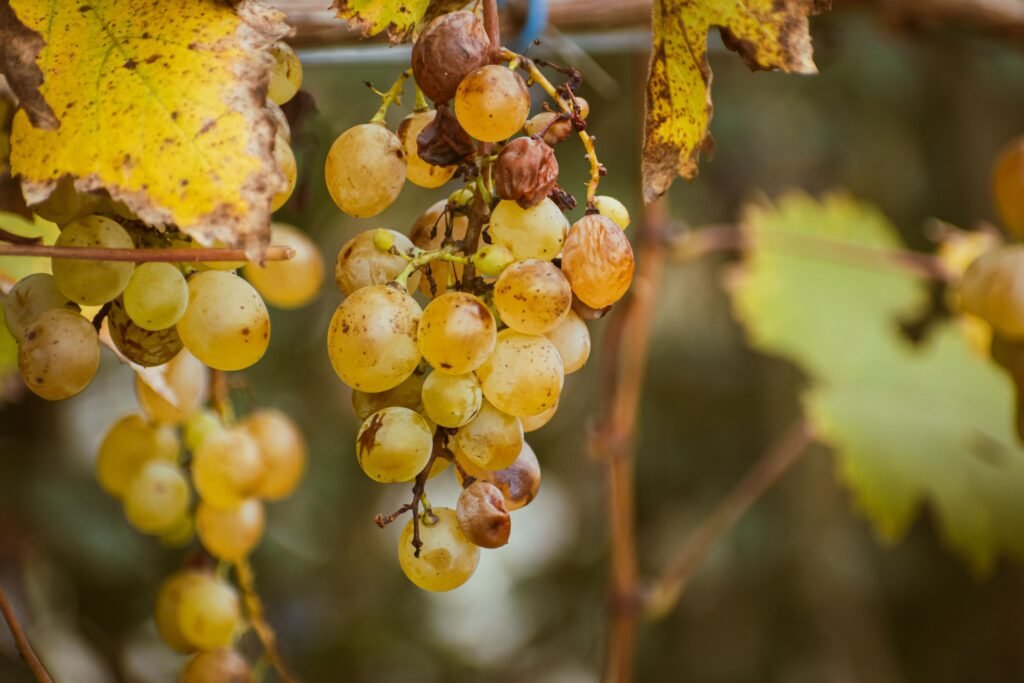
The grapes in Aszú
Aszú is a sweet wine produced in Central Europe primarily in North Eastern Hungary and Southern Slovakia. It obtains its sweetness as a consequence of a beneficial fungus which causes the skins to split and water to evaporate. This process concentrates the sugars, acids and flavours creating a full bodied, rich, and complex wine with high sugar and acid levels. Wines are characterised by dried fruit, apricot, orange marmalade, honey, ginger and beeswax aromas and flavours. It is thought that the best examples can comfortably age well over 100 years.
Aszú is a white wine made only from white grape varieties. Due to the fungus required to produce an Aszú wine, all of the grape varieties are ones which are suseptible to this fungus. They are also varieties which accumulate good levels of sugar, while also retaining sufficient acidity to provide balance. Over centuries, growers discovered that these grapes complement each other in a way that’s particularly suited to noble rot and long-lived sweet wines. The remarkable thing about Tokaj is that its signature style isn’t based on a single grape, although there are single varietal bottles.
The superstar – Furmint!
It is impossible to talk about Aszú, without also talking about the Furmint grape. This is the undisputed King of the Tokaj grapes and accounts for around 60-70% of all plantings in the region. Many wine lovers describe dry Furmint as sitting somewhere between Riesling (for acidity), Chenin Blanc (for texture and versatility), and Chardonnay (for body and oak compatibility). It is possible to make a characteristic Tokaj wine utilising only Furmint grapes, but it would be very difficult to make without incorporating Furmint in the blend.
Why Furmint?
The Furmint grape is one of the most distinctive grape varieties in the world. It is thought to have originated in the Carpathian Basin and it is deeply rooted in Hungarian viticultural history. The earliest records of Furmint can be found in the 17th Century, but it likely dates back even further than this. Plantings can also be found in Slovakia, Austria (where it is known as Mosler), Slovenia, Croatia and even as an import in places such as the USA.
The grape is early budding and therefore is particularly at risk from spring frosts. It is also a late ripening grape with a long growing season, typically being harvested in October to November. The berries themselves are small to medium sized and size is often inconsistent even within the same bunch. Typically skins are on the thinner side. Bunch clusters are medium-sized and tend to be cylindrical or slightly conical in shape. Wings of clusters can often develop off the main cluster. Growth is medium to high in vigour, so does require a degree of yield control and good canopy management.
The defining feature of Furmint grapes is the high levels of acidity that they retain. Even when fully ripened levels of malic and tartaric acid remain high, giving sharp, searing acidity in the wines. Juice tends to taste tart, green, lemony even at high sugar levels. This provides significant structure to the Aszú wines. In good vintages this searing acidity is also complemented by very high must weights (sugar levels). This this makes the variety quite rare, because it has the contrast between searing acidity and sweetness, creating balance. The wines often take on a degree of texture from the phenolic content of the berries. The result is a wine that can be quite grippy, even bitter; well structured with aging potential; and with a tannic feel (more noticeable in dry Furmint wines).
Most of the aromatics in the wines come from the fermentation and aging process, rather than aromats in the berries. Typically, young dry Furmint will have strong green apple and citrus flavours, with hints of pear, quince, white flowers and often minerality. Over time the wines mature to exhibit baked apple and dried fruit flavours, with stronger minerality and a waxy, honied, nutty and complex long finish. When noble rot occurs (which is the case in all Aszú wines) the flavour profile shifts towards apricot, dried fruit, orange marmalade, honey, baking spices (notably ginger), caramel, toffee, candied citrus peel and high levels of sugar. Wines always retain high acidity, despite sugar levels. When oaked expect vanilla, toast, a little softening and enhanced texture.
Hárslevelű
This is the second most planted variety in Tokaj is Hárslevelű, which accounts for around 20 – 30% of the plantings in the region. Hárslevelű generally provides a complimentary aroma and flavour profile to Furmint bring roundness and perfume. The name itself means Linden Leaf, a name it gets from the shape of its leaves and the floral aromas it produces which are reminicent of linden blossom. Outside of Tokaj, Hárslevelű can be found further West in Eger where it is used in some Egri Csillag, as well as in the Balaton region and outside of Hungary over the border in Austria.
Hárslevelű is medium to late in the season in terms of budding and tends to also ripen mid to late seasons as well. Due to this it tends to avoid spring frosts, while still being in its ripening phase at the end of the season when noble rot can form. Berries are medium sizes, rounded or slightly oval shaped with skins which are medium thickness. Clusters are medium to large and tend to be somewhat loosely grouped. If not controlled it can also be quite generous yielding, and it tends to prefer cooler, mist-influenced vineyards.
The aromatic profile of Hárslevelű is the presence of Linden blossom, honey, white peach, apricot, pear, herbal notes and sometimes baking spices such a clove and ginger. It tends to add elegance, softness, texture and some aromatic lift to Aszú wines. It is especially useful in vintages where Furmint achieves particularly concentrated acidity and is therefore sharper. The perfume and roundness it brings makes wines more approachable.
Sárga Muskotály
This is the third most planted variety is Sárga Muskotály (around 9-10%). This grape is probably more familiar to international readers and was likely around back in Ancient Greek times. Of the varieties so far, this one is definitely more fragrant and aromatic. And for this reason, it is often not used in significant quantity. Although it is possible to make a sweet wine from Sárga Muskotály on its own.
This variety is early ripening, and tends to produce small bunches more typical in shape as other more familiar varieties. Berries have a unique yellow colour, which goes a little rust brown with sun exposure. Skins are thin, and acidity is much lower than in the previous two varieties. Ripening tends to happen earlier in the season and the grape is highly expressive. Yields have to be managed carefully if it is being cultivated for aroma. This is a sun loving grape which prefer warm, sunny sites, but which also benefits from cooler nights which support aroma retention.
The aromas and flavours this grape contributes are typically orange blossom, citrus peel, rose petal, and some spice. And while it may sound strange to say, this variety is the variety which has the most grape-like taste. Aromas can sometimes take on a slight smell of turkish delight.
Other White Varieties
While the three varieties above dominate, there are three further varieties permitted in Aszú. Zéta, an indigenous crossing of Furmint and Bouvier, bred to ripen early and easily achieve high sugar levels. Kabar, a cross between Hárslevelű and Bouvier, known for its rich, spicy, and creamy texture. Kövérszőlő, a traditional (literally meaning “fat grape”) variety that ripens early and thrives in superb Aszú year. Of these Zéta develops noble rot very readily producing highly concentrated berries. Kövérszőlő, on the other hand, is know for its ability to accumulate sugar very easily. Combined they account for around 6% of total plantations.
Red varieties
Red varieties are not permitted in Aszú wines. However, contrary to popular belief, there are some winemakers who are developing wines with red grapes which are not sold under Tokaj PDO.
Blends and single varietals
As already stated, it is possible to make single variety Aszú wines, as well as blends. However, blends are usually dominated by Furmint (typically 50-90% of blends). Without Furmint the blends often loses their spine and structure. Hárslevelű often makes up between 10-40% of a blend. Sárga Muskotály where used typically contributes 5 – 10%, but occasionally up to 15%. Other varities are often used in much smaller proportions or as a balance to specific characteristics in certain vintages.
Whichever varieties are used, Aszú is influenced by the terroir and quality is tightly controlled by the PDO. As we will see in future articles, not only the varieties, but also the methods used are unique and are protected.
In the rest of this series we will uncover the distinctive features of Aszú, exploring the terroirs, production methods and styles which make Aszú unique. Hopefully you will discover why Aszú is so beloved in Hungary. And in the meantime, keep on exploring this beautiful planet we live on, one glass at a time.